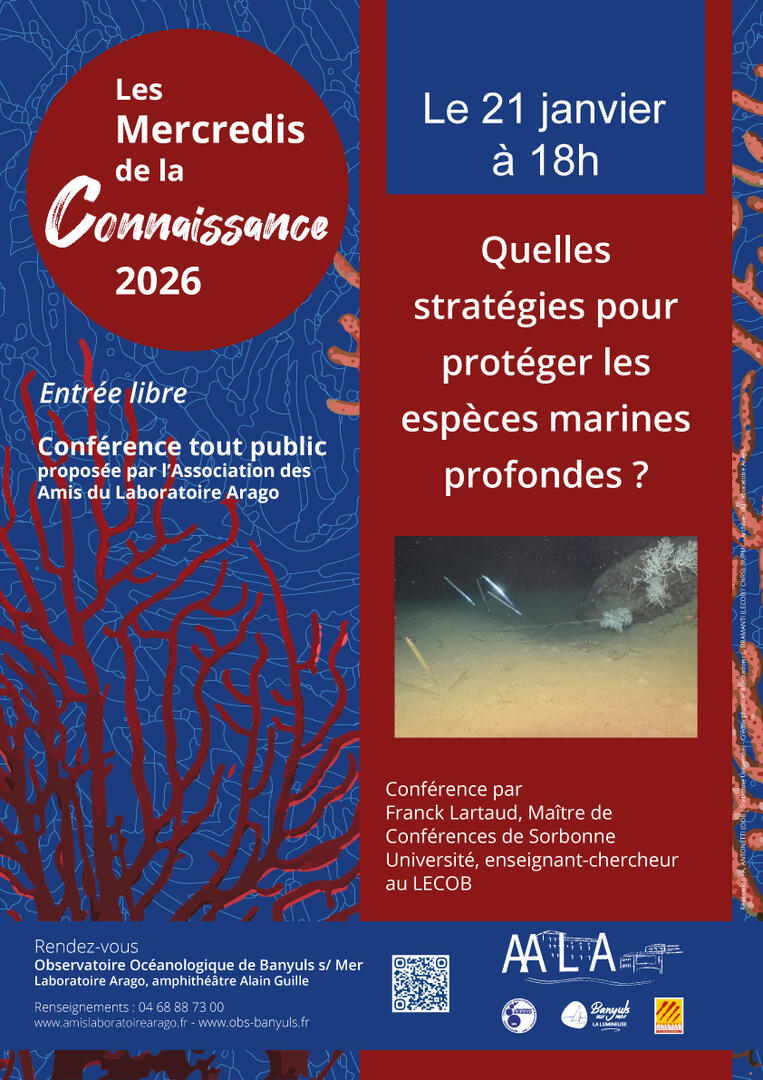
CONFERENCE LES MERCREDIS DE LA CONNAISSANCE - JANVIER
Science, Debate/conference, Cultural, Nature
in Banyuls-sur-Mer
-
What strategies are needed to protect deep-sea species?
Franck LARTAUD, 21 January 18h
Summary:
Growing pressure on marine environments and conflicts of use have developed in recent years, particularly around issues of food and energy security and habitat conservation. Measures to protect marine environments have been stepped up recently, with the establishment of Natura 2000 zones offshore, strong protection zones currently under discussion, and the extension of the Cerbère-Banyuls Marine...What strategies are needed to protect deep-sea species?
Franck LARTAUD, 21 January 18h
Summary:
Growing pressure on marine environments and conflicts of use have developed in recent years, particularly around issues of food and energy security and habitat conservation. Measures to protect marine environments have been stepped up recently, with the establishment of Natura 2000 zones offshore, strong protection zones currently under discussion, and the extension of the Cerbère-Banyuls Marine Nature Reserve.
Deep-sea environments, which are home to vulnerable marine ecosystems of recognised ecological interest, such as cold-water coral reefs, are particularly targeted. France's Mediterranean and Atlantic seaboards boast large expanses of deep reef zones, particularly in submarine canyons, which are home to a wide biodiversity of heritage and commercial species. But these habitats are facing the impact of fishing (particularly trawling), pollution (plastic waste) and global warming. Our European commitments aim to protect these fragile environments, but with what strategy? How effective? What are the solutions for the future and for passing on to future generations?
CV:
Franck Lartaud is a senior lecturer at Sorbonne University and a teacher-researcher at the Laboratoire d'Ecogéochimie des Environnements Benthiques (LECOB), at the Observatoire Océanologique de Banyuls-sur-Mer. He is developing research into the ecology of calcifying organisms (corals, bivalves) in relation to the effects of global change. His work includes the response of these organisms to climate change, plastic pollution and fishing pressure. This work is being carried out in a variety of habitats (freshwater, lagoons, submarine canyons, mid-ocean ridges), based on experimental studies carried out in the field (submersible missions in the Mediterranean, Atlantic and Pacific) and in aquariums, particularly on cold-water corals. The results are intended to help marine area managers and decision-makers adapt conservation measures.
Franck is also editor-in-chief of the scientific journal Vie et Milieu, based at the Observatoire Océanologique de Banyuls-sur-Mer, Deputy Director of LECOB and a member of numerous scientific councils linked to human activities at sea (floating wind turbines, extension of the port of Port-La-Nouvelle, Management Council of the Marine Nature Park, Steering Committee for Natura 2000 areas at sea, etc.).
Schedules
-
Schedules
-
- On January 21, 2026 at 6:00 PM